

Trump, Putin and Xi Issue Historic Joint Declaration on Global Peace, Nuclear Security and UN Reform
The United States, Russia and China issued a four-point declaration in Shenzhen on UN reform, energy supplies, international justice and nuclear risks. The post Trump, Putin and Xi Issue Historic Joint Declaration on Global Peace, Nuclear Security and UN Reform appeared first on BaretaNews.
BaretaNews - The People's Platform — feedPar Mark Baretajeudi 19 novembre 2026 à 17:06
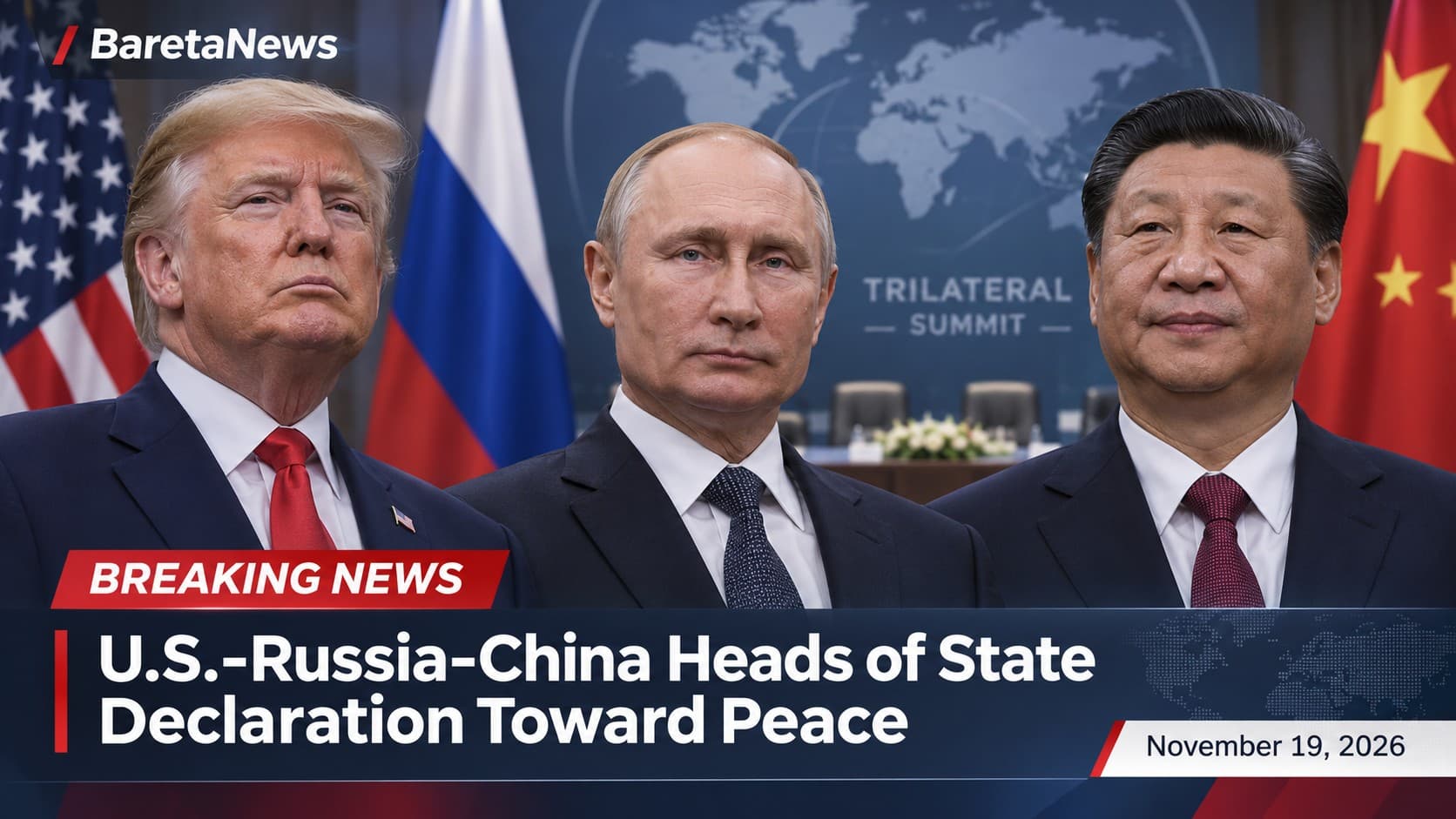
SHENZHEN, CHINA — 19 November 2026. US President Donald Trump, Russian President Vladimir Putin and Chinese President Xi Jinping have issued a joint declaration following their historic trilateral meeting in Shenzhen, setting out four commitments on United Nations reform, energy supplies, international criminal justice and nuclear risk reduction. The statement was published by the White House and China’s Ministry of Foreign Affairs. Their agreement signals an attempt at cooperation among three permanent members of the UN Security Council, although the declaration contains few operational details or implementation deadlines. Four commitments at the centre of the declaration United Nations reform. The leaders committed to reforming the UN so that it can respond more effectively to global challenges and fulfil its peace and security mandate. Their declaration does not identify specific reforms, changes to Security Council representation or a timetable. Energy security. The three governments said they planned to increase production and supply of refined petroleum products and emphasised stable energy flows. They did not announce country-by-country output targets or pricing arrangements. International criminal justice. The declaration stresses state consent and immunities for state officials. It argues that the International Criminal Court and comparable institutions must not exceed their jurisdiction. The language is likely to prompt scrutiny from those concerned about balancing sovereign immunity with accountability for serious international crimes. It does not itself amend the ICC’s founding treaty or jurisdiction. Nuclear risk reduction. The leaders reaffirmed that nuclear war cannot be won and should never be fought. They pledged dialogue on reducing nuclear risks and preventing proliferation, but announced no binding arms-reduction agreement or verification mechanism. Why the meeting matters — and what remains unresolved The Shenzhen meeting brought together leaders whose governments have frequently differed over global security. A shared statement may create space for further talks, but the text does not resolve the war in Ukraine or other ongoing conflicts, nor does it commit the governments to regular future summits. The difference between a declaration of principle and enforceable policy is crucial. UN reform faces formidable political and legal hurdles. Energy markets respond to actual supply decisions, not simply diplomatic intentions. Nuclear arms control requires sustained negotiations, verification and confidence-building. Potential implications for Africa For African states, the UN reform language is noteworthy because African governments have long sought more equitable representation in the Security Council. Yet the declaration offers no explicit commitment to permanent African seats. Its energy provisions could eventually affect importers and exporters, depending on the policies that follow. The reference to international courts also raises questions for conflict-affected countries, including Cameroun. However, the joint declaration contains no specific statement on the Southern Cameroons conflict, Ambazonia or the NERA 10. It would be premature to infer a policy change on those issues. The next test is implementation The significance of this meeting will depend on whether Washington, Moscow and Beijing produce measurable progress on nuclear diplomacy, energy commitments and UN reform. For now, the Shenzhen declaration is a notable political signal rather than a comprehensive peace settlement. Sources: White House declaration, 19 November 2026; Chinese Ministry of Foreign Affairs declaration; Associated Press summit report.
Mis à jour Il y a 1h